In the 1970s, Klaus Ager composed a series of works entitled Silences for various instruments. The title of the pieces refers to subtle sounds which — at times themselves on the threshold of audibility — illuminate silence.
Silences VII for piano four hands was composed in 1972/73 during Ager's studies with Olivier Messiaen and Pierre Schaeffer in Paris. The composer's accommodation provided not only a grand piano, but also an extraordinary cutlery set by Neuzeughammer Ambosswerk. The Amboss 2060 cutlery, designed by Carl Auböck in 1955/56, became the characteristic preparation of the piece and, to this day, has not been used in any other composition. The work is performed entirely inside the piano. Additional experimental sound-producing objects such as a metal chain, a tin can, a plectrum, an eraser, a flannel cloth, and thin paper are also employed.
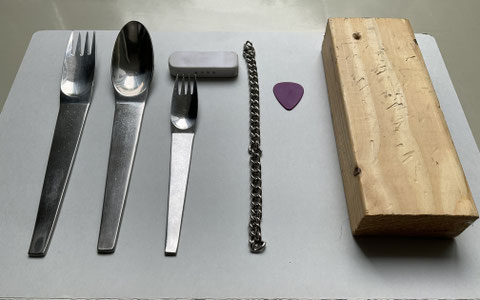
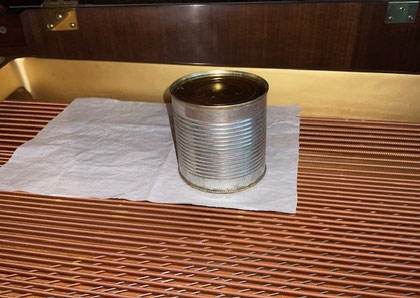
Seven pieces of cutlery (spoons or forks) are attached to seven different pitches for the duration of the entire piece. Care must be taken that, in the trichord register, the individual pieces are inserted identically between the first and second strings using the handle end, and positioned as precisely as possible at a right angle to the strings. The spoons are set into vibration by hand, causing the handle to make repeated contact with the strings and produce subtle sounds. Another playing technique requires an additional smaller fork with which the cutlery is struck at four different points. Combined with the vibration of the string, this creates sound mixtures of varying complexity — the piano becomes a glockenspiel. A precise but not overly forceful attack is required,

since the cutlery can easily topple over, leading to the "collapse" of the preparation or to unwanted extraneous noises. The indicated dynamics should therefore be understood relatively, within the delicate sonority of the preparation.
The playing fork is also used to produce gliding pitches by tapping the string with the end of the fork handle and then guiding it along the string. The handle end functions as a bridge, dividing the string at the point of the desired pitch. A more strongly accented variant is produced by plucking the string with a plectrum.
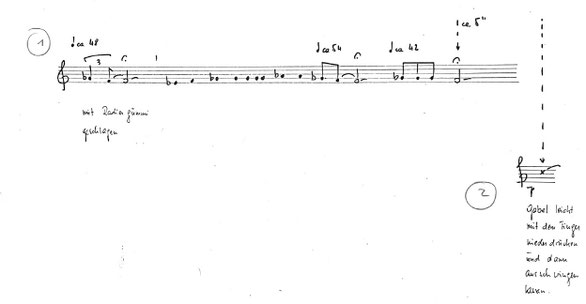
For melodic declamation, a fork with an eraser skewered onto it serves as a mallet. Percussive effects are also produced with the cutlery handle on the strings, on the agraffes, and on a piece of wood placed on the soundboard.
These playing techniques open up a wide spectrum of timbral nuances, including fixed and gliding pitches, inharmonic bell spectra and noises, as well as different attack-decay characteristics.
Recording: Silences VII (Per Rundberg, Klaus Ager, Piano)
Publisher: Edition7
Website: Klaus Ager